News · Spain
Pérez-Llorca and IE Examine the New European Sustainability Regulatory Framework
Pérez-Llorca hosted a new session of the Pérez-Llorca/IE Chair in Madrid entitled "The Reform of the CSRD and CSDDD Directives: A New Framework for Sustainability Reporting and Corporate Due Diligence." The event examined the legal landscape following the publication of Directive 2026/470 in the Official Journal of…
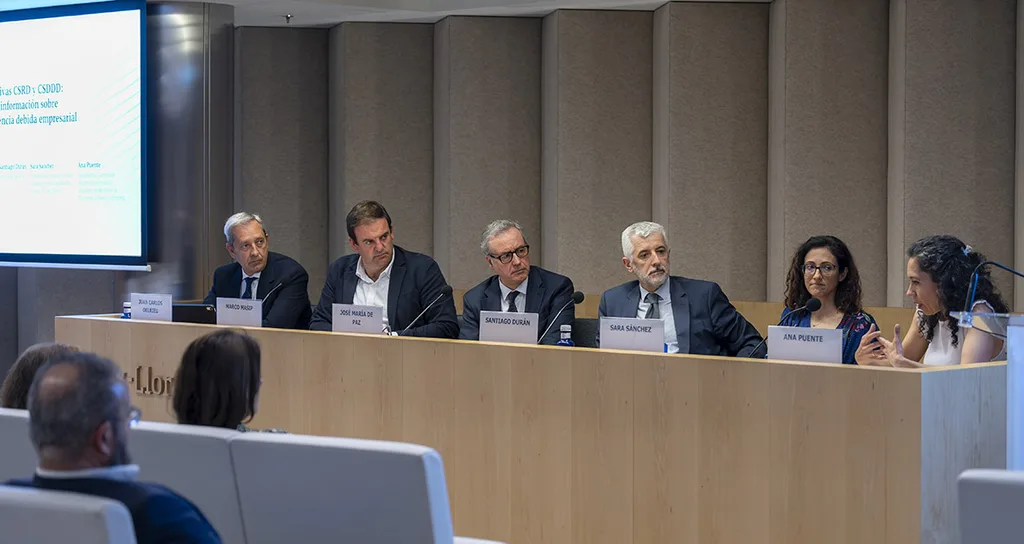
Pérez-Llorca hosted a new session of the Pérez-Llorca/IE Chair in Madrid entitled "The Reform of the CSRD and CSDDD Directives: A New Framework for Sustainability Reporting and Corporate Due Diligence." The event examined the legal landscape following the publication of Directive 2026/470 in the Official Journal of the European Union on 26 February 2026.
The session was moderated by José María de Paz, Partner in ESG and Climate Change Regulation at Pérez-Llorca, and featured Ana Puente, Deputy Director General for Sustainable and Digital Finance at the Ministry of Economy, Trade and Business; Santiago Durán, President of the Institute of Accounting and Auditing of Accounts (ICAC); Juan Carlos Delrieu, Director of the ESG Office at Bank of Spain; Marco Masip, Director of ESG Strategy and Reporting at Telefónica; and Sara Sánchez, Associate Professor and Head of the Private Law Department at IE Law School.
During the session, participants analyzed how Directive 2026/470 narrows the scope of certain corporate sustainability obligations and introduces significant changes affecting the availability and quality of sustainability information. The discussion focused on the simplification of the CSRD and CSDDD frameworks and the substantial reduction in the number of companies subject to reporting requirements.
The panel also examined the technical and legal consequences of the reform. Santiago Durán noted the risks associated with revising a regulatory framework before its full implementation, highlighting concerns regarding the system’s ability to provide a true and consistent representation of sustainability information in light of the reduced scope and verification requirements.
Sara Sánchez addressed the legal implications of the reform for corporate due diligence and emphasized that the simplification process results in a significant reconfiguration of the civil liability regime. She noted that the fragmentation of applicable rules may increase complexity and legal uncertainty for companies.
Participants also discussed the consequences of the reduced regulatory perimeter, which could place the number of companies required to report sustainability information within an estimated range of 300 to 600 entities. They agreed that successive regulatory changes introduced before the original framework had been fully implemented have generated uncertainty and complicated corporate planning.
Juan Carlos Delrieu highlighted the implications that reduced information availability may have for financial supervision and risk management. He stressed that simplifying sustainability disclosures should not be interpreted as deregulation and that reduced corporate reporting may limit the data available to banks for identifying, measuring and managing risks, with potential consequences for financial stability.