News
Ibero-America agrees AI alliance to cooperate on data, models and computing
The agreement reached in Madrid provides for voluntary participation, national control over data and models in the region’s languages, alongside non-binding data protection standards
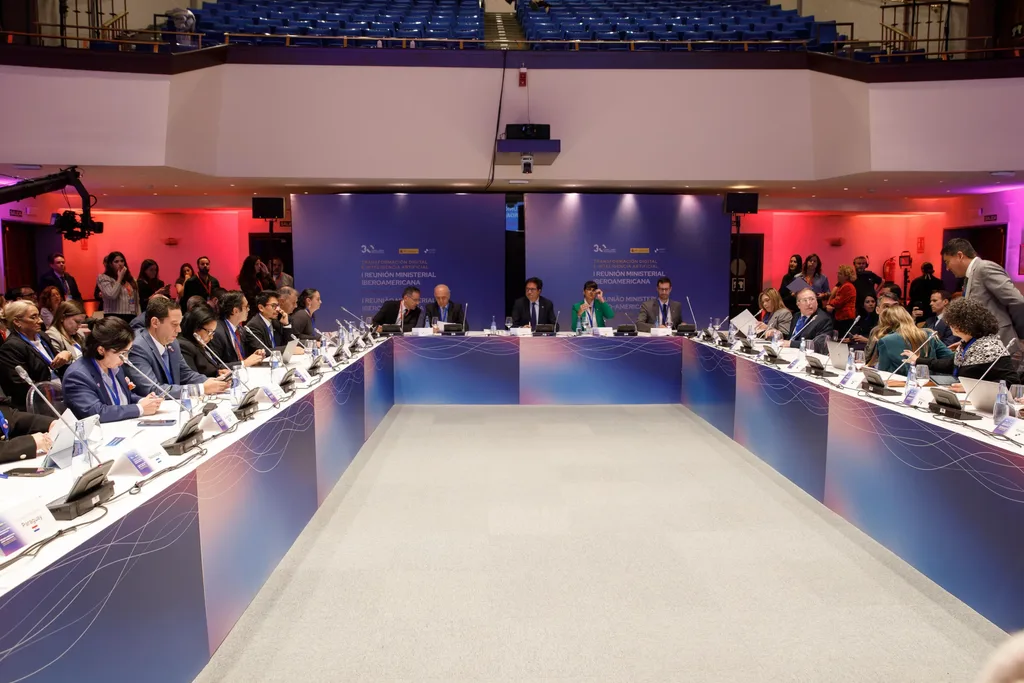
Ibero-American countries agreed on 3 November in Madrid to establish the Ibero-American Artificial Intelligence Alliance, a cooperation initiative to strengthen the region’s digital and cultural sovereignty and develop a common agenda on the technology.
The agreement was reached at the first Ibero-American Ministerial Meeting on Digital Transformation and AI. Its adoption by heads of state and government was scheduled for the XXX Ibero-American Summit, convened in Madrid on 4 and 5 November.
The alliance was open to voluntary participation by member states of the Ibero-American Conference, with three pillars: access to quality data, development of models tailored to regional languages and needs, and cooperation on computing for applications intended for researchers, public administrations and businesses.
On data, the countries agreed to promote an Ibero-American Data Space for AI systems serving the public interest. It will have a federated design, with each country deciding what information to share and under what conditions. The aim is to incorporate corpora, public documentation and other sources representative of the region’s priorities, languages, cultures and social realities.
Technology cooperation will cover models and systems in Spanish, Portuguese, other official languages and Indigenous languages, for use by public administrations, citizens, universities, research centres and businesses. A shared foundation will enable national, linguistic and sector-specific adaptations, as well as adaptations for specific uses.
The assets identified included existing language models, public assistants, corpora and sector-specific solutions, such as ALIA, AMALIA, from Portugal, LATAM GPT, promoted by Chile, and SoberanIA, from Brazil.
On computing, the approach was to coordinate available resources and connect supply and demand, without the need to create new regional infrastructure. Participation will entail shared responsibility and public contributions, financial or in kind, depending on national circumstances and under a common governance model.
The Madrid Declaration, signed at the meeting, set out commitments on rights, sustainability, inclusion, security and privacy, as well as opportunities in health and education. The countries advocated protecting rights and freedoms in digital environments too, and called for responsible AI, cybersecurity and age-appropriate, bias-free environments. They linked these safeguards to trust, innovation and economic and social benefits.