Intellectual Property
Dual Duo Ambush: The Legal Boundaries of Real-Time Marketing
By Crystal Lo · Head of China Desk
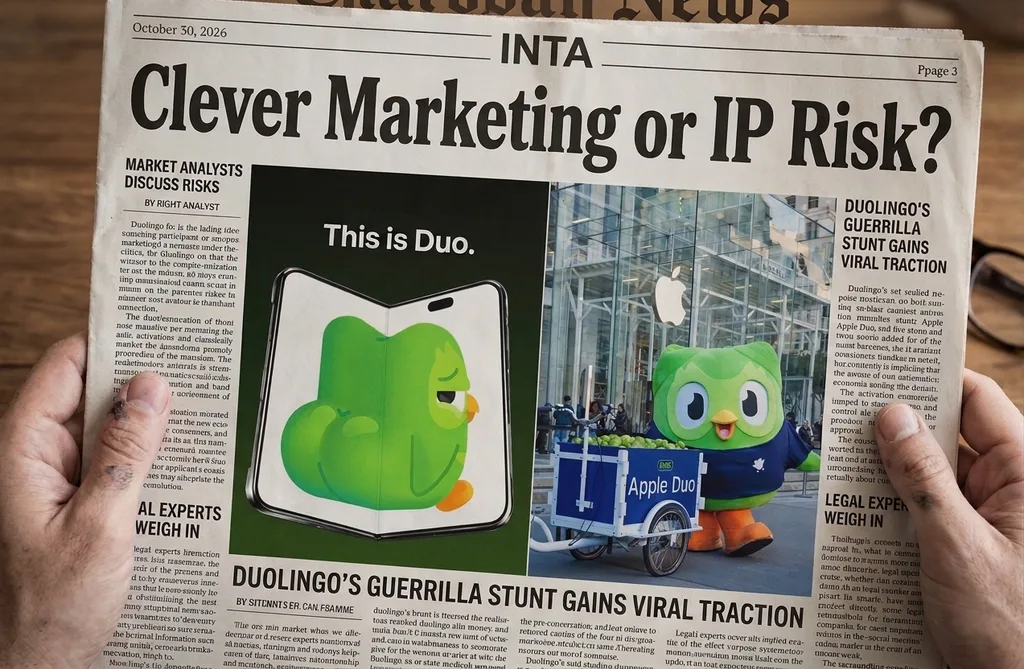
When Apple unveiled its iPhone Duo, language-learning app Duolingo, whose mascot is a green owl named Duo, seized the opportunity to post a pun on social media (pictured above) and set up a cart just outside Apple’s flagship store in New York to hand out green apples with QR codes urging passers-by to complete their daily language lessons. The campaign played on the word “Duo” and the iconic fruit associated with the brand.
Latin Counsel spoke with two intellectual property specialists representing key markets in Latin America and Asia: Leandro Barbas, partner at LB Intellectual Property in Brazil, and Albert Tsui, partner at law firm Anjie Broad, who practices in Hong Kong and mainland China. Together, they break down the legal limits of reactive marketing and examine how the rules differ between Brazil and China.
The in-house counsel’s playbook: Identifying risks and non-negotiable red lines
When examining the fine line between clever real-time marketing and intellectual property infringement, fair and responsible play is the common premise underpinning the Latin American and Asian perspectives of Barbas and Tsui. The primary goal of in-house counsel is not to block ideas, but to ensure campaigns strike a balance between creativity and regulatory compliance.
Across jurisdictions, risk assessment boils down to four main operational areas:
- Trademarks and logos: Using third-party brand names versus uniquely designed logos.
- Creative assets: Reproducing protected advertising designs, official product renderings or copyrighted images.
- Verifiable claims: Avoiding false or misleading statements about a competing company.
- Physical activations: Managing on-the-ground logistics, municipal permits and private property boundaries.
The experts also agree on several absolute red lines:
- Directly copying logos and campaign materials to such an extent that the work ceases to be humorous commentary and becomes intellectual property infringement.
- Deliberately fabricating an official alliance or association.
- Disseminating false factual claims.
- Defaming or disparaging a competitor.
The compliance dilemma: When to sue and when to let it go
Despite the provocative nature of ambush-style campaigns, affected brands rarely bring immediate trademark or copyright claims. Trademark law is primarily designed to protect source identification—ensuring consumers can distinguish who provides a good or service—rather than giving companies absolute ownership over any public use of their names.
Beyond the legal arguments, brands must weigh the strategic risks before taking action:
- The Streisand effect: Filing a formal lawsuit over a light-hearted campaign often backfires by amplifying the joke, extending its media life cycle and giving the disruptor far more free publicity than the original campaign generated.
- Public relations backlash: Taking a humorous mascot or clever campaign to court can make a corporate giant appear heavy-handed or unreasonable, damaging its reputation and consumer goodwill.
- Proportionate response: In many cases, trademark owners find that sending a confidential cease-and-desist letter or simply letting the viral moment pass delivers a much better commercial outcome than launching high-risk litigation.
“The absence of a lawsuit does not prove that a campaign is legal,” Barbas says. Tsui adds that “although small-print disclaimers help clarify that there is no official authorization, they cannot remedy obvious visual copying.”
When these campaigns cross borders, however, local regulatory frameworks introduce very different compliance realities.
Regional divergence: Brazil versus China
While the conceptual approach to real-time marketing is broadly similar around the world, enforcement mechanisms differ substantially across regions.
Brazil: Balancing legal freedom with advertising ethics
In Brazil, assessing a reactive campaign requires grounding the analysis in national industrial property rules and advertising self-regulatory standards. Barbas stresses that while local trademark law protects registered marks, legal provisions explicitly safeguard public discourse:
“Brazil’s Industrial Property Law (Federal Law No. 9,279/1996) protects registered trademarks and provides remedies for infringement and unfair competition. On the other hand, Article 132, IV, states that the owner of a registered trademark may not ‘prevent the mention of the mark in speeches, scientific or literary works, or any other publication, provided that such use has no commercial connotation and does not harm the mark’s distinctiveness.’”
Barbas also notes that campaigns must comply with advertising codes enforced by CONAR, which regulates comparative advertising and ambush marketing (carona and emboscada). Ultimately, physical activations require careful management of property rights and permits, ensuring the campaign remains recognizable as a piece of creative commentary rather than a misleading association.
China: Strict administrative enforcement and a ban on “free-riding”
By contrast, carrying out a similar guerrilla campaign in mainland China exposes brands to a much stricter regulatory environment. Albert Tsui notes that common defenses based on fair use of trademarks, such as the descriptive use of words, are subject to strict limits:
“Even if Duolingo has successfully carried out ambush marketing campaigns elsewhere in the world without infringing IP rights, in China it faces a different set of rules under the AUCL (Anti-Unfair Competition Law). The 2025 amendment to the AUCL, Article 7 (Commercial Confusion), strictly prohibits free-riding on another party’s reputation, even if direct consumer confusion about the product’s origin is debatable. Unlike Western jurisdictions, where disputes are primarily civil, local market regulators can act quickly on competitors’ complaints, imposing fines and confiscating promotional materials on the spot.”
Conclusion
Modern consumers expect brands to connect with culture in real time, placing marketing at the boundary between creativity and commercial identity. As Barbas observes, legal frameworks must protect public discourse: the question is not whether a campaign capitalizes on a rival’s momentum, but how it contributes to the conversation; transparent jokes deserve room to breathe, while misleading campaigns create legal liability.
However, as Tsui notes, drawing on his previous experience as in-house counsel at major technology companies such as Google, Lenovo and Motorola, navigating this line ultimately depends on a company’s risk appetite. While hardware giants with supply-chain exposure must adhere to strict compliance, more agile software disruptors may view calculated legal risks as worthwhile trade-offs for viral reach.
Note: INTA will hold its 2026 Leadership Meeting in Phoenix, Arizona, US, from November 17 to 20, 2026. Albert Tsui, mentioned in this article, will attend the event. Please feel free to contact Tsui if you will be attending.