Intellectual Property
Strategic IP realignment: McDonald’s leaves FIFA to build its own assets
By Crystal Lo · Head of China Desk
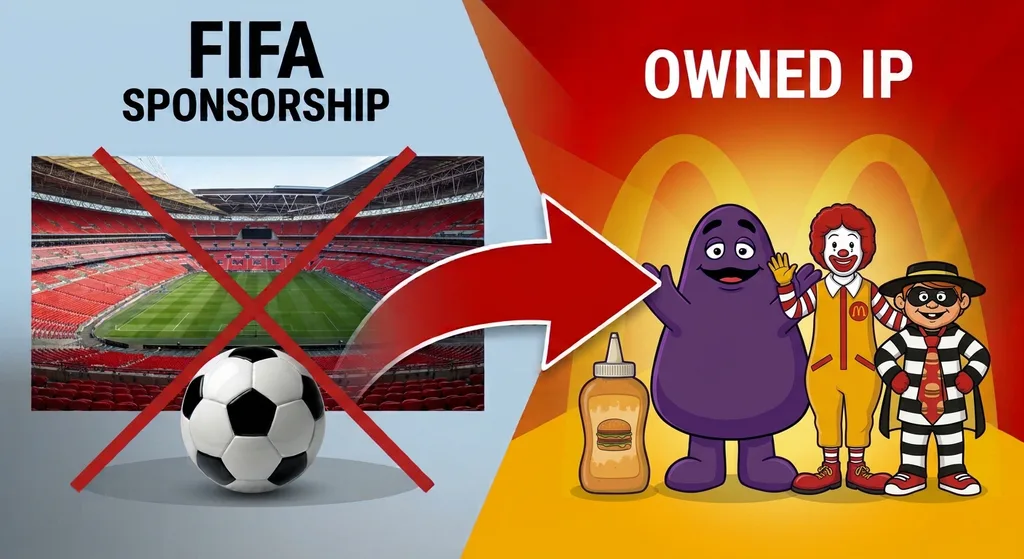
After more than three decades as an official global sponsor of the FIFA World Cup, McDonald’s announced that it would end its flagship sports sponsorship after the 2026 tournament. The decision marks a fundamental shift in modern intellectual property and brand strategy, highlighting a growing tension in corporate marketing: the trade-off between licensing external IP (“borrowed IP”) and cultivating owned assets (“owned IP”).
A 32-year partnership reaches its limit McDonald’s sponsorship of the FIFA World Cup began in 1994, granting the brand exclusive global activation rights in the fast-food category. However, despite carrying out the largest global marketing effort in the company’s history for the 2026 World Cup across more than 110 markets, executives publicly reported that performance fell short of expectations.
“I think we’ve become overly reliant on borrowed IP.” — Morgan Flatley, McDonald’s Global Chief Marketing Officer
McDonald’s is reallocating capital to year-round activation of its owned properties.
Measuring Return on IP Investment (ROIP) Assessing sports sponsorship rights requires looking beyond high-level impressions and measuring Return on IP Investment:
IP ROI = (Net financial value generated - Total IP acquisition and activation costs) / Total IP acquisition and activation costs
- Direct revenue attribution: It is difficult to isolate the impact of sponsorship from routine promotional activity.
- Brand equity and preference: Heavy reliance on temporary event cycles rather than long-term brand value.
- Advertising value equivalency: Declining effectiveness due to ad blockers and multi-screen viewing.
- Asset longevity: Rights expire as soon as the contract term ends.
With official sponsorship packages costing tens of millions per cycle, on top of mandatory activation budgets of 1:1 or 2:1, transient sales spikes are difficult to justify on an ROI basis.
The commercial power of owned IP The economic case for shifting from borrowed to owned assets is clear in McDonald’s commercial performance. Licensing third-party trademarks creates a rental model in which value expires when the contract ends, while owned IP generates lasting value:
- Direct asset value: The first numbered bottle (#1 of 200) of McDonald’s-owned Big Mac Special Sauce was auctioned for more than $18,000 USD, while vintage 1970s store memorabilia featuring the original McDonaldland characters routinely sells for between $3,500 and $12,000 USD on the secondary market.
- Revenue drivers: The “Grimace Birthday” campaign in 2023 drove U.S. same-store sales up 10.3% in a single quarter and generated $6.5 billion in global revenue, an increase that senior management directly attributed to the character’s revival.
- Brand equity accumulation: Owned characters (Grimace, Hamburglar) and trade dress appreciate in value over time and remain 100% owned assets, avoiding ongoing licensing fees or territorial limits.
Ambush marketing and value erosion A key factor undermining official rights is ambush marketing, in which non-sponsor brands associate themselves with an event without paying official licensing fees; this was widely discussed at INTA’s annual conference in London earlier this year.
- Sponsor burden: Official sponsors pay premium fees for exclusive category rights and rigorous enforcement.
- Ambush dynamics: Unofficial brands leverage contextual imagery, real-time social media commentary and viral posts to capture attention at a fraction of the cost.
- The enforcement gap: Rights holders cannot trademark general sports themes, meaning aggressive protection against non-sponsors often triggers public relations problems.
Takeaways for IP counsel For IP lawyers and brand strategists, McDonald’s strategy highlights how legal teams can actively support long-term asset value beyond traditional prosecution and rights compliance:
- Portfolio audit and alignment: Assess whether licensing and sponsorship agreements deliver lasting brand value or merely temporary, non-retainable visibility.
- Protecting defensible characters and trade dress: Prioritise robust, multi-jurisdictional registration of secondary assets such as characters, vintage marks, trade dress and proprietary recipes to secure exclusive, high-margin merchandising rights.
- Ambush strategy and enforcement: Advise management teams on the structural limits of protection against ambush marketing during major events, helping balance the legal costs of protecting temporary rights against building proprietary brand barriers.